
What Is a Quartz Worktop Made Of
Key Takeaways
- A quartz worktop is an engineered stone made from 90–95% crushed natural quartz bound with 5–10% polyester or epoxy resin, pigments, and additives.
- The manufacturing process involves quarrying, crushing, mixing with resin in a vacuum, pressing under vibration, curing in ovens, calibrating, and polishing.
- Quartz worktops are non-porous, meaning they resist stains from substances like tea, wine, and turmeric and do not require annual sealing.
- Unlike natural granite, the resin content in quartz makes it susceptible to scorching or cracking from extremely hot pans, requiring the use of trivets.
- Quartz provides consistent color and pattern compared to natural stone and requires low maintenance, needing only daily wiping with warm, soapy water.
| Quick answer
A quartz worktop is an engineered stone surface made from roughly 90–95% crushed natural quartz bound with about 5–10% polyester resin, pigments and additives, then compressed, cured and polished into slabs. Unlike granite or marble, it isn’t cut from a single block of stone, it’s manufactured, which is why it’s non-porous, colour-consistent and doesn’t need sealing. |
If you’re renovating a kitchen anywhere in the UK, you’ve almost certainly had quartz worktops recommended to you, by a kitchen showroom, a fitter, or a friend who fitted one last year and won’t stop talking about it. It’s now one of the most fitted worktop materials in British kitchens, sitting alongside granite, laminate and solid wood on most suppliers’ price lists.
But “what is a quartz worktop made of” is a fair question, because the marketing rarely says. It isn’t a single mineral slab like granite. It’s an engineered product, and knowing exactly what’s in it helps you judge quality, compare quotes, and understand why one quartz worktop costs £300 per linear metre, and another costs £900.
What’s Actually Inside a Quartz Worktop?
A quartz worktop is made from crushed natural quartz aggregate bound together with resin under heat and pressure. The exact split varies by manufacturer, but most premium brands sold in the UK, Caesarstone, Silestone, CRL Stone and Compac among them, sit in a fairly tight range.
- Natural quartz aggregate, 90–95%: crushed and graded into different particle sizes. This is where the hardness comes from, quartz sits at 7 on the Mohs scale, harder than a kitchen knife blade.
- Polyester or epoxy resin, 5–10%: acts as the binder, filling every gap between the quartz particles so the finished slab has virtually no pores for bacteria, oil or wine to get into.
- Pigments, trace amounts: produce the colour, from pure white through to charcoal, and can mimic marble veining or granite speckling.
- Additives, trace amounts: resins that boost UV stability, heat tolerance and flexibility so slabs don’t crack in transit or during fitting.
This is the detail most articles skip, and it matters: a worktop with a genuinely high quartz content will feel colder to the touch, resist scratching from knives and pans, and hold its colour for decades. A cheaper slab with more resin filler tends to feel warmer, scratch more easily, and can yellow slightly under strong sunlight over the years, worth asking your fabricator about if you’ve got a south-facing kitchen.
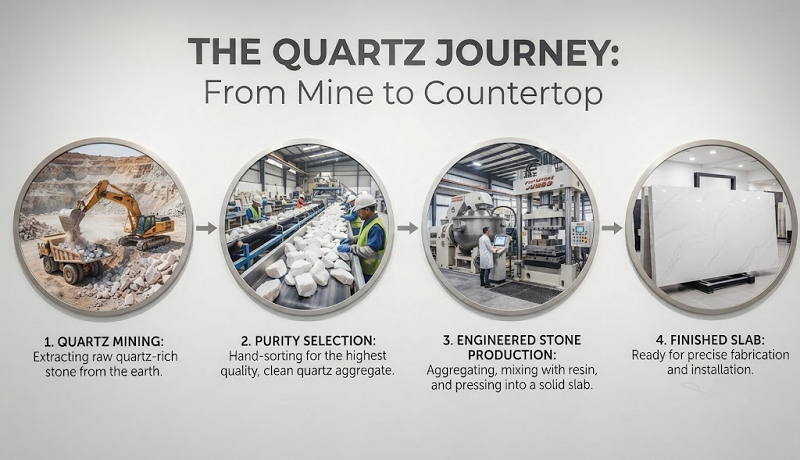
How Are Quartz Worktops Manufactured?
Every UK quartz brand follows broadly the same industrial process, whether the slab is finished in Israel, Spain, Turkey or Italy before shipping to a British fabricator.
1. Quarrying and crushing
Raw quartz is quarried, then crushed into a mix of particle sizes, from fine powder through to larger chips, which is what gives finished slabs their depth and texture rather than a flat, uniform look.
2. Mixing with resin and pigment
The crushed quartz is blended with resin, pigment and additives in a vacuum mixer. Getting this ratio right is where quality brands separate from budget ones, too much resin and the slab loses hardness; too little and it won’t bind properly.
3. Pressing (the Bretonstone process)
The mixture is poured into moulds and compacted under vacuum and vibration, a technique most of the industry licenses from Breton SpA in Italy. This forces out air bubbles, which is why quartz doesn’t have the pinholes you sometimes see in cheaper stone products.
4. Curing
Slabs go through curing ovens at high temperature so the resin hardens fully and binds the quartz particles permanently.
5. Cooling and calibrating
Slabs are cooled slowly to avoid stress cracks, then calibrated to a consistent thickness, usually 20mm or 30mm for UK kitchen worktops.
6. Polishing and finishing
The surface is ground and polished to the finish you choose, gloss, matt, or a leathered texture, then cut to size by your fabricator once they’ve templated your kitchen.
Why UK Homeowners Choose Quartz Over Other Stone
Quartz sits in the middle of the market: pricier than laminate, generally comparable to or slightly above mid-range granite, but with a few practical advantages that matter in everyday British kitchen life.
It won’t stain from tea, wine or turmeric
Because it’s non-porous, quartz resists the stains that granite and marble are prone to, genuinely useful if your kitchen sees a lot of curry paste, red wine or builder’s tea.
No annual sealing
Granite and marble need resealing every year or two to stay stain-resistant. Quartz doesn’t, because there’s no natural porosity for the resin to compensate for. That’s one less job on the household to-do list.
Consistent colour and pattern
Because it’s manufactured rather than quarried, what you see on the showroom sample is what turns up on your kitchen island, there’s no risk of the natural veining looking completely different slab to slab.
Good hygiene
The sealed, non-porous surface makes it harder for bacteria to take hold, which is part of why quartz is also popular in bathrooms and utility rooms, not just kitchens.
Heat resistance, with a caveat
Quartz tolerates everyday heat well, but the resin content means it isn’t as heatproof as solid granite. Always use a trivet or heat pad for pans straight off the hob, putting a hot pan directly on quartz is one of the most common ways UK homeowners damage a brand-new worktop in the first year.
How Much Does a Quartz Worktop Cost in the UK?
Prices vary by brand, colour and thickness, but as a rough guide, most UK kitchen fabricators quote somewhere between £250 and £600 per linear metre installed for standard colours in 20mm or 30mm, rising toward £700–£900+ for premium finishes, statement veining, or waterfall edges on an island.
How Do You Look After a Quartz Worktop?
Quartz is low-maintenance rather than no-maintenance. A few habits keep it looking new for decades:
- Wipe daily with a soft cloth and warm, soapy water, no special cleaner needed.
- Avoid bleach-heavy or highly alkaline cleaning products, which can dull the resin’s shine over time.
- Skip abrasive scouring pads, they can scratch the polished finish.
- Always use a chopping board; quartz resists knife marks but isn’t knife-proof.
- Use a trivet for hot pans and dishes straight from the oven or hob.
Bottom Line
A quartz worktop is engineered stone, mostly natural quartz, held together with resin, pigment and a handful of performance additives, manufactured under factory conditions rather than cut from a single block. That’s exactly why it behaves differently to granite or marble: more consistent, easier to live with day to day, and virtually maintenance-free, in exchange for being slightly less heat-tolerant. For most UK kitchens, that trade-off is exactly why quartz has become the default recommendation.
Frequently Asked Questions
Q1 Is quartz worktop real stone?
Partly. It’s roughly 90–95% real, natural quartz stone, crushed and bound with resin and pigment. That makes it an engineered stone rather than a solid natural stone like granite or marble, but the hardness genuinely comes from real quartz mineral.
Q3 Do quartz worktops need sealing?
No. Because the resin fills every pore during manufacturing, quartz is non-porous straight out of the factory. Unlike granite or marble, it never needs sealing or resealing.
Q4 Are quartz worktops heat-resistant?
They handle everyday warmth well, but the resin content means direct contact with a hot pan or oven tray can cause scorching or cracking. Always use a trivet, this is the single most common cause of quartz worktop damage.
Q5 What’s the lifespan of a quartz worktop?
With reasonable care, most manufacturers back their quartz worktops with warranties of 10–25 years, and in practice a well-fitted quartz worktop can easily last the lifetime of the kitchen, 20 years or more, without losing its finish.

