
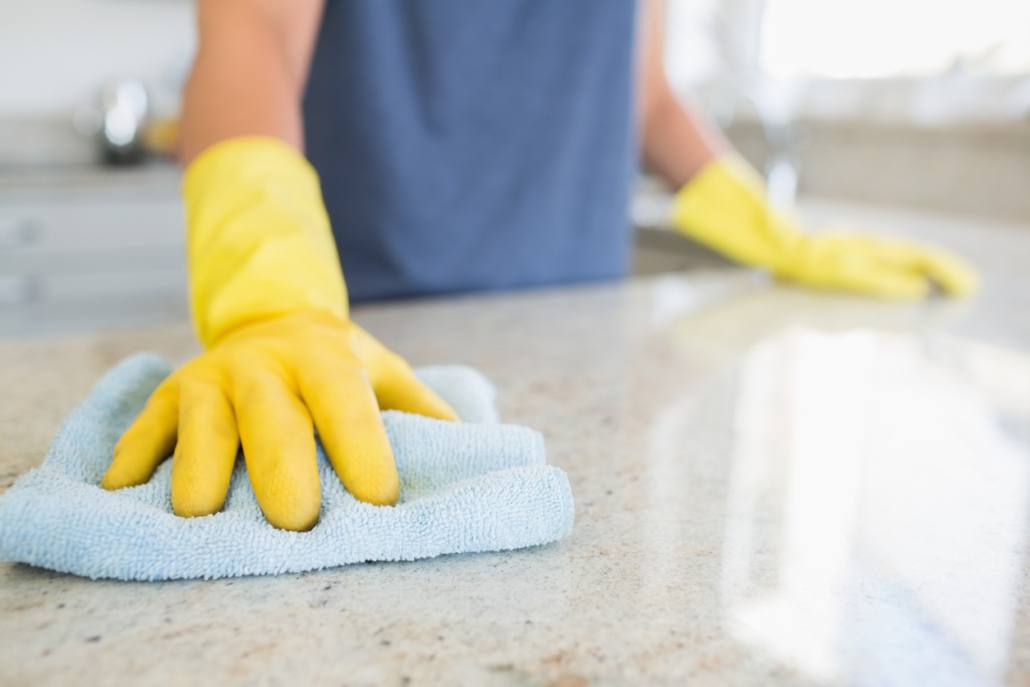
How to Clean Granite Countertops
Key Takeaways
- Wipe up spills immediately and clean daily with warm water, mild washing-up liquid, and a soft cloth, then dry the surface.
- Avoid using acidic substances like vinegar and lemon juice, harsh chemicals like bleach, or abrasive scouring pads that can damage the sealant and polish.
- Reseal granite worktops roughly once a year or every 12 to 18 months, which can be easily tested using a simple water-bead check.
- Treat specific stains appropriately, using hydrogen peroxide for food and drink, a baking soda paste for oil and grease, and natural stone products for limescale.
- Always use chopping boards and trivets, avoiding cutting directly on the stone or placing hot pans straight onto the surface.
Quick Answer: Wipe up spills as they happen. Clean daily with warm water and a few drops of ordinary washing-up liquid, using a soft cloth, then dry it. Don’t use vinegar, lemon juice, bleach, or anything abrasive. Reseal roughly once a year. That’s genuinely most of it. Everything below is the detail for the bits people get wrong or ask about most.
If you’ve just had granite fitted, someone at the showroom probably told you it’s “practically maintenance-free.” That’s true, mostly. It’s also the kind of thing that gets people into trouble, because “low maintenance” gets heard as “does it matter what I use on it,” and the answer to that one is yes, quite a lot.
We fabricate and fit granite worktops for a living, so we get asked about cleaning almost as often as we get asked about colour. This is the answer we actually give people, not the laminated care card version.
What You Actually Need To Clean Granite
Nothing exotic, and if a cleaning product tries to sell you a whole granite-care starter kit for £40, you can politely ignore it.
- A soft microfibre cloth (a couple of these , one for washing, one for drying)
- Mild washing-up liquid, non-acidic
- Warm water
- A granite-safe sealer, for once or twice a year
- Optional: isopropyl rubbing alcohol, if you want to make your own disinfecting spray (recipe below)
Cleaning It Day To Day
This is the bit that actually protects the stone long-term , not the sealing, the daily habit.
- Deal with spills straight away. Oil, wine, coffee, anything acidic , the longer it sits, the more chance it has to work into the surface, especially if your sealant’s a year or two old and starting to wear thin.
- Wipe down with warm, soapy water. A few drops of washing-up liquid in warm water is genuinely enough. You don’t need a granite-specific spray for this part, though one won’t hurt.
- Dry it. People skip this step and then wonder why the worktop looks streaky rather than shiny. A dry microfibre cloth after cleaning takes ten seconds and makes the difference.
Once a week, give it a slightly more thorough going-over , the same soap and water, but actually get into the areas around the hob and sink where grease tends to build up without being obvious. Granite hides grime well, which is a blessing and a curse.
The isopropyl cleaner we actually use
This is the one our fitters use on site after installation, and it’s easy enough to make at home.
You’ll need:
- 1–2 tbsp washing-up liquid
- 3–4 tbsp isopropyl rubbing alcohol
- 2 cups (about 480ml) warm water
- A spray bottle, if you want one , a bowl works too
How to use it: mix everything together, wet a cloth (or spray directly), and go over the worktop, working a bit harder on any dried-on marks. Dry it off afterwards. The alcohol helps disinfect without leaving the surface cloudy the way some supermarket antibacterial sprays can.
If you’d rather skip the alcohol, swap it for 10–15 drops of tea tree or lavender oil instead , you lose a bit of the disinfecting punch but gain a worktop that smells genuinely nice, not “hospital clean.”
What NOT to use and why people get this wrong
This is where most of the damage we see actually comes from, and it’s rarely dramatic. Nobody’s chucking bleach on their worktop on purpose. It’s usually smaller things:
- Vinegar or lemon juice, because someone read a “natural cleaning” article that treats every surface the same way. Granite isn’t glass or tile , it’s a natural stone with a sealant sitting on top, and acid eats through that sealant faster than it looks like it’s doing anything.
- Bleach, usually for “disinfecting properly.” It dulls the finish over time and isn’t necessary , soap and water, or the isopropyl mix above, does the job.
- Scouring pads or abrasive powders, on the theory that a stubborn mark needs elbow grease. Granite’s hard, but the sealant and polish on top aren’t invincible, and a scourer will dull the shine in the exact spot you scrubbed.
- Leaving fruit bowls or wine glasses sitting for days. Not a cleaning product mistake, but the same principle , acid plus time equals etching, even on a well-sealed surface.
Getting stains out
Sealed granite resists staining well, but “resists” isn’t “immune,” and every worktop picks up the odd mark eventually.
Food and drink stains (wine, coffee, fruit juice) , start with warm water and a mild soap. If that doesn’t shift it, mix equal parts water and hydrogen peroxide, dab it on, leave it for a few minutes, then rinse and dry. Don’t leave it on longer than that “just to be thorough” , a few minutes is enough.
Oil and grease stains , these are the ones plain soap struggles with, because oil doesn’t dissolve in water the way you’d want it to. A stone-safe degreaser works, or make a paste from baking soda and a little water, spread it over the mark, and leave it for 15–20 minutes before wiping and rinsing.
Hard water marks , usually around the tap or draining area. Warm water and a cloth handles most of it. For anything stubborn, use a limescale remover made for natural stone , not the bathroom descaler under your sink, which will almost certainly be acidic.
Old, set-in stains , if something’s been there a while and won’t budge, a granite poultice powder (from any stone-care supplier) is worth trying before you assume it’s permanent. It pulls the stain out from underneath rather than just cleaning the surface, and it’s slower but genuinely works on marks that look hopeless.
Test anything new on a small, hidden corner first. It sounds like standard advice everyone ignores, and most of the time you’d get away with skipping it , but the one time it matters, it really matters.
Do this / don’t do that
| Do | Don’t |
| Wipe spills up immediately, especially wine, oil and citrus | Use vinegar, lemon juice, bleach or ammonia |
| Clean daily with mild soap and warm water | Scrub with anything abrasive |
| Use a chopping board and trivets, always | Cut or put hot pans straight onto the surface |
| Reseal every 12–18 months | Let acidic liquids sit “just for a bit” |
How to tell if it needs resealing?
Here’s a genuinely useful trick, and it takes two minutes: pour a small puddle of water onto the worktop , about the size of a coin , and leave it for 15–20 minutes. If it’s still sitting there as a bead, your sealant’s doing its job. If it’s soaked in and darkened the stone underneath, that’s your sign. Not an emergency, but worth sorting soon.
Resealing, step by step
- Clean the worktop and let it dry completely , sealant won’t bond properly over a damp or greasy surface.
- Apply a granite sealer evenly, following whatever the product says (they vary slightly).
- Leave it to sit , usually 15–30 minutes, check the bottle.
- Wipe off any excess with a clean, dry cloth before it fully cures.
- Let it dry completely before you use the worktop again. Don’t rush this bit; give it the full time.
Most granite worktops need this once every 12–18 months, though it depends on how heavily the kitchen’s used and how it was sealed originally. We stock a pH-neutral cleaner and sealer suited to most granite finishes.
If it chips or cracks
It happens , usually from something heavy being dropped on an edge, not from normal use. Small chips can be filled with a colour-matched stone paste, and if it’s done well you’ll struggle to spot it afterwards. Bigger cracks need more care, and it’s worth checking what’s underneath , if the worktop isn’t properly supported at that point, the crack can come back even after a good repair. If in doubt, get it looked at rather than filling it yourself and hoping.
bottom line
Granite is one of the easiest worktop materials to live with, as long as you treat it like stone and not like laminate. Wipe spills up quickly, clean with something mild, dry it, and reseal it once a year or so. Do that, and it’ll outlast most of the kitchen around it.
People Ask Questions
Q1 Can I use vinegar or lemon juice on granite?
No. Both are acidic enough to etch the stone and wear down the sealant faster than normal use would.
Q2 Can I use a steam cleaner?
Generally yes, on granite that’s properly sealed , it lifts grease well without chemicals. Worth doing the water-bead test first, since steam on unsealed or poorly sealed stone can push moisture into the surface.
Q3 How often should I reseal?
Every 12–18 months as a rule of thumb, though the water-bead test is the more reliable way to check , some worktops need it sooner, some later, depending on how much the kitchen gets used.
Q3 What’s the best product to actually buy?
Anything labelled specifically for natural stone and pH-neutral. Avoid anything marketed as a general “multi-surface” spray , they’re rarely formulated with granite in mind.


Leave a Reply
Want to join the discussion?Feel free to contribute!