
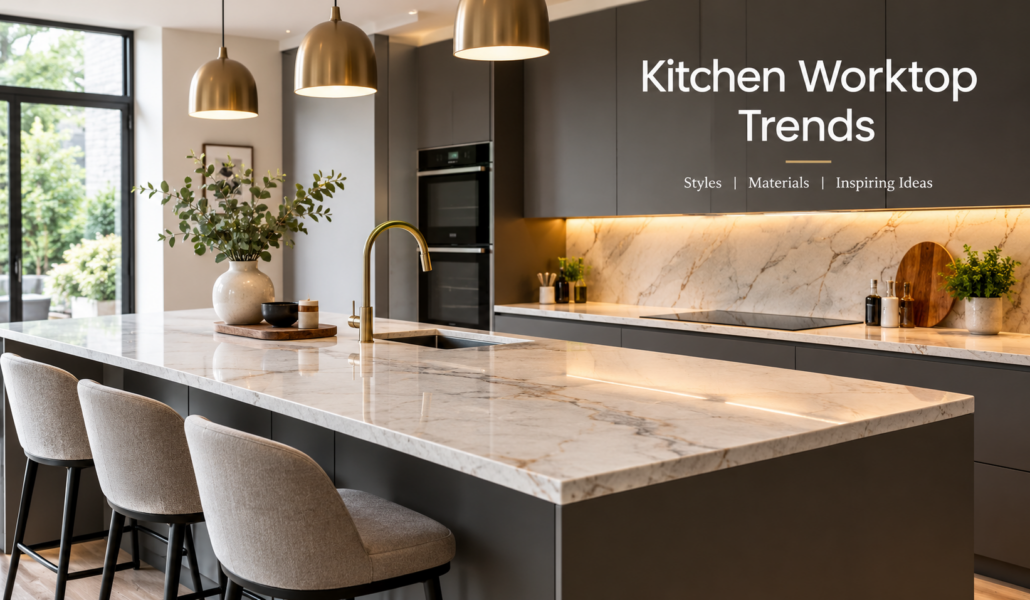
2026 Kitchen Worktop Trends: Colours, Materials & Ideas
Key Takeaways
- British kitchens for 2026 are shifting towards organic warmth, moving away from stark white units and icy grey worktops in favour of sand, clay, taupe, warm greige, and soft limestone tones.
- Quartz remains popular but with a warmer palette, featuring richly veined marble-effect stones, while porcelain, sintered stone, and wood make strong comebacks for enhanced durability and accent features.
- Kitchen islands take centre stage with waterfall ends, curved corners, and thicker profiles, often using high-contrast stone to create a clear focal point.
- Matte, honed, and leathered finishes are replacing shiny, reflective surfaces to better hide fingerprints and water marks while providing a tactile, premium look.
- Technology is becoming more integrated and quieter, featuring concealed induction hobs and under-counter LED strip lighting designed to highlight natural stone textures.
If you’ve started looking into kitchen trends 2026, you’ve probably noticed the same word popping up again and again: warmth. After a decade of stark white units and icy grey worktops, British kitchens are shifting towards something softer, richer and a lot more forgiving to live with day to day.
This isn’t a fleeting look. It’s a genuine change in how people use the room. Kitchens now double as dining rooms, home offices and the place everyone ends up standing around with a cup of tea, so the worktop has to do more than look good in a showroom photo. It has to hold up to real life while still feeling considered. Here’s what’s actually driving kitchen designs for 2026, straight from the surfaces homeowners and fabricators are choosing right now.
What are the biggest kitchen trends for 2026?
In short: warm neutrals over cool minimalism, bolder veined stone for statement islands, matte and textured finishes instead of gloss, and worktops that quietly hide technology rather than show it off. Wood is back, porcelain is rising fast, and lighting has moved from the ceiling down onto the worktop itself. We’ll go through each of these in more detail below.
Kitchen Colours Trend For Your Kitchen
The biggest shift by far is colour. Bright white units and cold grey worktops, the default for the last ten years, are giving way to what many designers are calling “organic warmth.” Think sand, clay, taupe, warm greige and soft limestone tones rather than anything that reads as clinical.
Deeper shades are having a moment too. Earthy reds, chocolate browns, sage and forest greens, and dusty blues are appearing on cabinetry and worktops alike, often paired with a neutral backdrop so the room doesn’t feel overwhelming. Two-tone kitchens are especially popular this year: a darker, richer shade on the island paired with lighter perimeter units, or vice versa, gives the space depth without shouting about it.
If you’re planning a refresh and want a colour that won’t feel dated by 2028, warm neutrals with subtle veining are the safest long-term bet. They pair with wood, brass and matte black hardware equally well, which matters if your taste (or your kitchen) changes down the line.
Statement worktop materials leading kitchen designs
Quartz, but warmer: Quartz hasn’t gone anywhere, but the palette has moved on. Calacatta Gold and other richly veined marble-effect quartz are the standout choice for islands this year, prized for their sun-warmed, gold-flecked look that pairs naturally with brass taps and handles. Alongside it, softer sirocco-style tones (sand, rose, amber) are proving just as popular for buyers who want warmth without a bold pattern.
Porcelain and sintered stone are having a breakout year: These surfaces bring the same durability as quartz with even better heat and scratch resistance, plus the ability to run the same finish across the worktop, upstand and splashback for a seamless look. For busy households, this is quickly becoming the practical favourite.
Wood is making a genuine comeback: Oak, walnut and even bamboo worktops are back in demand, usually as an accent (an island, a breakfast bar, open shelving) rather than across the whole kitchen. Paired with quartz or ceramic elsewhere, wood softens a scheme that might otherwise feel too hard-edged.
Granite is quietly re-emerging: As quartz has become more uniform and mass-produced, some homeowners are rediscovering granite for its one-of-a-kind veining. It’s not overtaking quartz, but it’s earning a place alongside it, particularly in period or character properties.
Kitchen islands take centre stage
Open-plan living has made the island the real focal point of the kitchen, and worktop design is following suit. Waterfall ends, where the worktop material runs straight down the sides of the island to the floor, are everywhere this year, as are curved and softened corners that make an island feel sculptural rather than boxy.
Thicker profiles are back too. Instead of the thin, low-key edges that dominated the last few years, 2026 favours worktops with real visual weight, sometimes built up to look even chunkier than they physically are. A popular styling trick worth borrowing: use a bold, high-contrast stone on the island and keep the perimeter worktops calmer, so the eye has one clear place to land.
Texture over gloss: matte, leather and tactile finishes
Shiny, reflective worktops are losing ground fast. Matte and honed finishes are the new default because they hide fingerprints and water marks far better, and because they simply feel calmer in a busy family kitchen. Leathered quartz, with its soft, slightly grained texture, is becoming a popular upgrade for anyone who wants a premium look without the maintenance worries of natural stone.
This love of texture extends beyond the worktop itself. Ribbed and fluted cabinet fronts, tactile splashback tiles, and brushed metal hardware are all part of the same story: kitchens are meant to be touched, not just looked at.
Smart and sustainable kitchen worktops
Technology is getting quieter, not louder. Integrated induction hobs, with the controls built directly into the worktop surface, are becoming standard in mid-to-high-end kitchens because they’re easier to clean and look far more streamlined than a separate hob and control panel. Boiling and filtered water taps continue to grow in popularity too, cutting down on kettle clutter while shaving water use thanks to better aeration technology.
Sustainability is playing a bigger role than it used to. Non-porous quartz and sintered stone need no sealing and last for decades, which matters more to buyers than it did five years ago. Integrated, monolithic sinks, where the bowl is formed from the same material as the worktop, are also on the rise, partly for the seamless look and partly because there’s nowhere for grease or grime to collect around a joint.
Small kitchen ideas 2026
Not every kitchen is getting an island, and the latest kitchen ideas 2026 take that seriously. In smaller spaces, the same principles apply on a tighter scale: large-format worktops and matching splashbacks reduce visual clutter and make a room feel bigger, while a single warm, natural-toned surface does more visual work than several competing materials.
Smart storage remains the real hero here. Deep drawers instead of cupboards, splashback tiling that runs to the ceiling, and floating shelves in place of bulky wall units all free up worktop space without making the kitchen feel cramped.
Lighting and detail: the finishing touches
Lighting has moved off the ceiling and onto the worktop. Under-cabinet and under-edge LED strips are now used to highlight the texture and veining of a stone worktop rather than just to illuminate the counter, and LED lighting hidden in an island’s skirting board has become a favourite way to make it feel architectural after dark. Expect to see this paired with vintage-style pendant lighting for contrast, adding a bit of warmth and personality against all that clean stone.
Kitchen trends 2026 UK
UK kitchens have their own take on all this. British buyers tend to favour more restrained, wearable colour palettes than some of the bolder looks coming out of continental Europe, leaning towards warm neutrals and muted earth tones rather than saturated colour. Practicality also carries more weight here: durability, easy cleaning and value for money consistently rank alongside looks in UK renovation surveys, which is part of why quartz and porcelain remain the two most requested materials for kitchen worktops across the country, even as colours and finishes evolve.
Open-plan living, still the most common layout for UK new-builds and extensions, is also pushing the island-focused trends above. If you’re renovating in the UK this year, the worktop is arguably the single decision worth spending the most time on, since it needs to work with your cabinetry, your lighting and your daily routine for the next decade or more.
People Also Search
Q1: What worktop colour is trending in 2026?
Warm neutrals lead the way: sand, taupe, warm greige and soft limestone tones, along with richer earthy reds, browns and sage greens used as accent colours on islands or cabinetry.
Q2: Is quartz still popular in 2026?
Yes, Quartz remains the most requested UK worktop material, but the look has shifted towards warmer, gold-veined and sirocco-style tones rather than the stark whites and greys that dominated previous years.
Q3: What is the most durable kitchen worktop material?
Porcelain and sintered stone currently offer the best all-round durability, resisting heat, scratches and staining better than most quartz and all natural stone, while quartz remains a close second for everyday practicality.
Q4: Are wooden worktops coming back?
Yes, particularly as an accent on islands or breakfast bars rather than across an entire kitchen, paired with quartz, porcelain or ceramic elsewhere in the room.
Q5: What is the best worktop for a small kitchen?
A single, warm-toned quartz or porcelain surface run across the worktop and splashback works best, reducing visual clutter and helping a compact kitchen feel larger.
